Aligning Quest Marker Pulsations with Underlying Objective Priorities in Mission Planning Interfaces
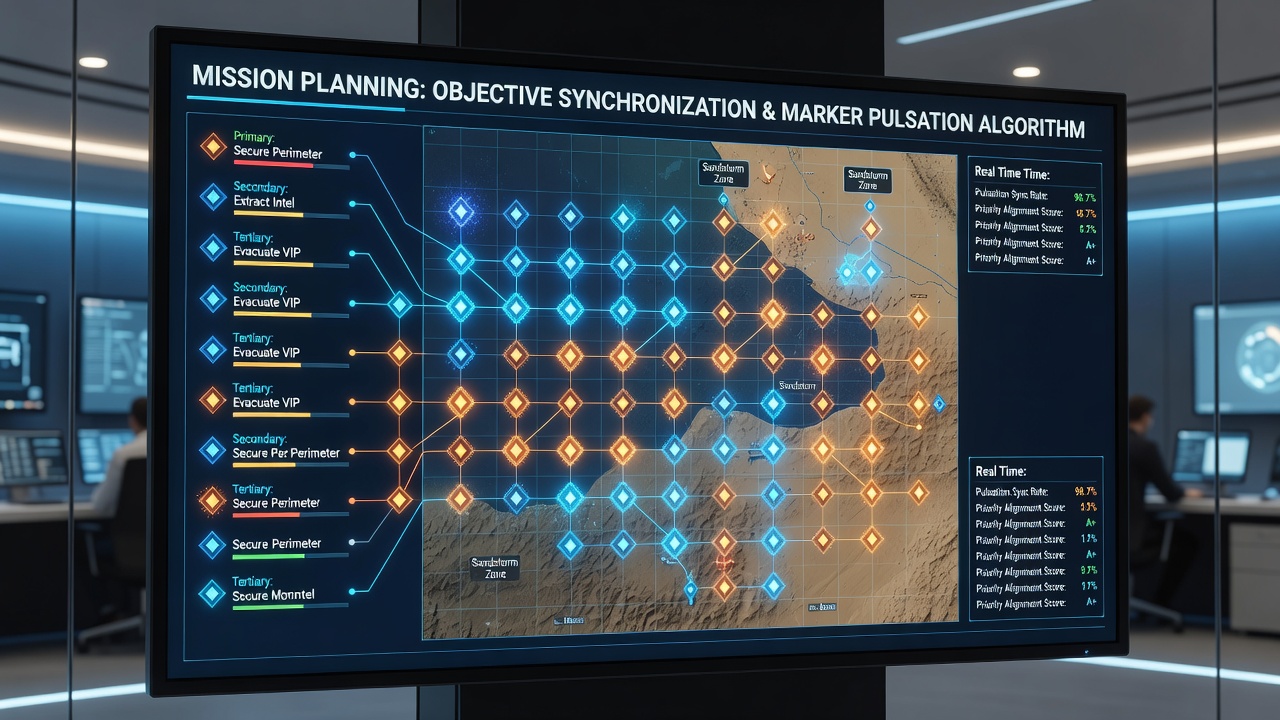
Game interfaces often rely on visual cues to guide player attention during complex mission sequences, and quest marker pulsations represent one established method for signaling objective importance. Researchers in human-computer interaction have examined how varying pulse rates and intensities can correspond to priority hierarchies, allowing players to distinguish between primary goals and secondary tasks without consulting separate menus. Data from interface testing sessions indicate that synchronized pulsation patterns reduce decision latency when users scan crowded mission maps.
Core Mechanics of Pulsation Alignment
Quest markers in mission planning interfaces typically employ rhythmic visual feedback where pulse frequency increases in direct proportion to objective urgency. High-priority targets might display rapid oscillations while lower-priority elements maintain slower, steadier rhythms. Interface designers calibrate these rates using established visual perception thresholds, and studies from cognitive psychology labs confirm that the human visual system detects frequency differences most effectively within specific ranges. Developers integrate these findings into planning tools by mapping objective metadata directly to marker behavior, so that a change in mission priority automatically adjusts the corresponding pulsation without manual intervention.
Priority Encoding Through Visual Rhythm
Objective priorities receive encoding through multiple synchronized attributes including pulse speed, amplitude, and color saturation. Teams working on large-scale strategy titles have implemented layered systems where a single marker can communicate both task type and urgency level through combined visual signals. One documented approach assigns baseline pulse intervals to each priority tier, then applies real-time modifiers based on proximity or resource constraints. Observers note that this method maintains clarity even when multiple markers occupy the same screen region, because distinct rhythmic patterns remain perceptually separable.
Implementation Patterns Across Development Pipelines
Development studios incorporate priority alignment during the interface prototyping phase, often using modular scripting frameworks that link quest data structures to visual rendering pipelines. Programmers define priority values as numerical weights, and these weights drive shader parameters responsible for marker animation. When mission parameters shift during live events or player choices, the system recalculates weights and updates pulsation behavior instantaneously. Reports from middleware providers show that such dynamic linking reduces the need for separate UI update passes, which in turn lowers overall frame-time costs in performance-critical sections.
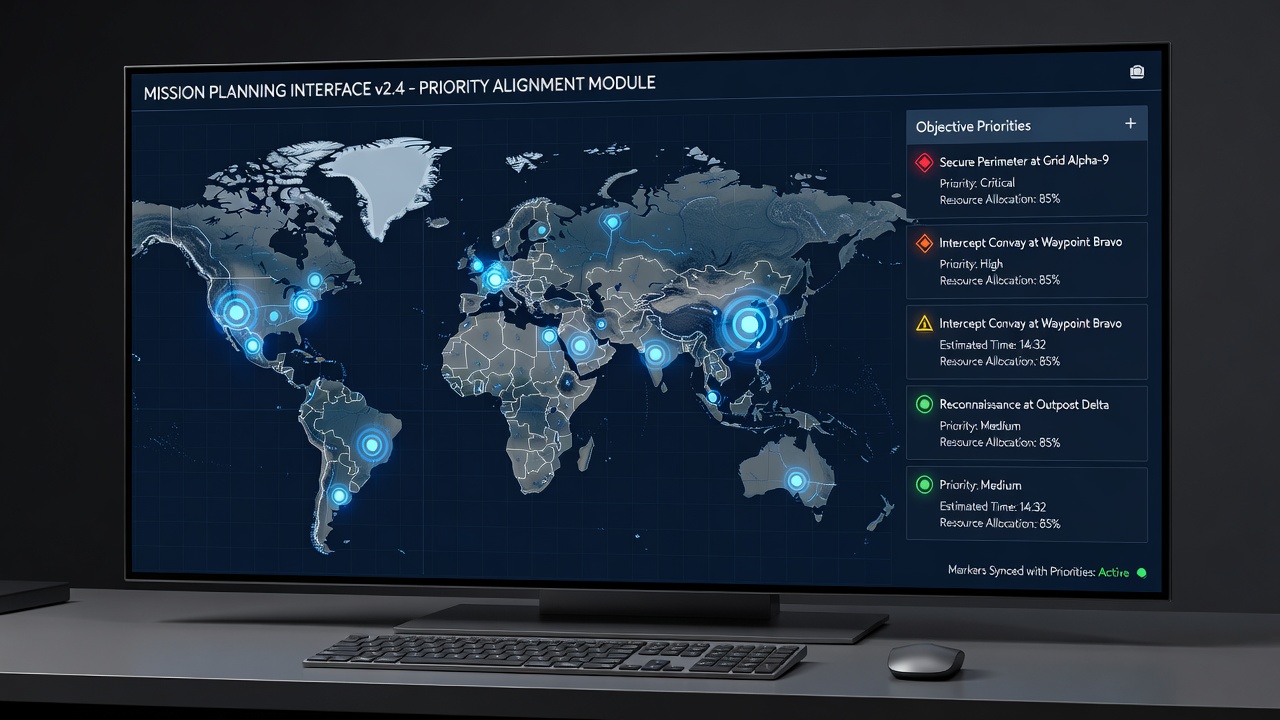
Testing protocols frequently include eye-tracking studies to verify that players allocate attention according to intended priority gradients. Participants complete standardized mission scenarios while researchers record fixation durations adn transition paths between markers. Results from these sessions reveal consistent correlations between higher-priority pulsations and increased visual dwell time, confirming that the alignment functions as designed. Adjustments to pulse curves occur iteratively based on aggregated performance metrics collected across demographic groups.
Data Sources and Industry Benchmarks
Industry organizations such as the International Game Developers Association publish annual surveys that track adoption rates of advanced visual cue systems. Figures from the 2025 survey indicate rising integration of priority-linked animation across both independent and AAA productions. Academic groups at institutions including the University of Waterloo have released papers detailing perceptual models for rhythmic interface elements, providing developers with quantitative guidelines for pulse rate selection. These models factor in variables such as screen resolution, viewing distance, and color contrast to optimize marker visibility under varied conditions.
Updates Emerging in Mid-2026
During July 2026 several engine updates introduced refined tools for automating pulsation alignment. New node-based editors allow designers to connect objective priority fields directly to animation curves, eliminating manual keyframing for each mission variant. Early adoption data shared at developer conferences suggest these features accelerate iteration cycles by measurable margins, particularly in titles that feature branching mission structures. Compatibility layers ensure older projects can incorporate the new systems without extensive refactoring.
Player Performance Metrics
Analytics platforms record how players interact with aligned markers during extended play sessions. Metrics such as objective completion order and route efficiency show measurable shifts when pulsation alignment is present versus when it is absent. One analysis of anonymized telemetry from a cooperative action title demonstrated that teams using synchronized interfaces completed priority-driven objectives at higher rates during time-limited encounters. These patterns hold across different controller schemes and input methods, indicating the benefit stems from the visual design rather than hardware-specific factors.
Conclusion
Alignment between quest marker pulsations and objective priorities continues to evolve as both perceptual research and engine tooling advance. Current implementations rely on direct data mapping, iterative testing with eye-tracking validation, and ongoing refinement through industry benchmarks. As development pipelines incorporate more automated synchronization features, the precision of these visual systems is expected to increase further while maintaining compatibility with existing mission planning frameworks.